

A little over a year ago, I reached out to a guy called Ravishankar Iyer on WhatsApp. Therein lie multiple tales, and I shall tell you all of these tales today.
CWC
The first of these tales is about a community called The Clear Writing Community. Amit Varma, wearer of many hats, runs an online course called The Art of Clear Writing.
Regular readers of this blog may be surprised to learn that I had taken this course back in 2020. (I should hasten to add that you shouldn’t be updating your priors about Amit as a teacher. You should be reinforcing your priors about my laziness as a student.)
But as I tell everybody who is considering doing this course, you should do it because Amit maximizes soul. The online sessions are great, but the better payoff is being a part of a lovely community.
This community has many offshoots, including city-wise chapters, and various hobbyist groups. I have become a lurker on pretty much every single community I am a part of, and I’m certainly not claiming that I am an active participant on any of them1. But I love reading the links that people share on the CWC community, and it is an amazing bunch of kind, well-read people. Join Amit’s writing course as much (more, in fact) for the community as for the learning.
Ravishankar has also done this course, and is therefore a part of the same WhatsApp community. He writes a weekly newsletter called the 3-2-1 newsletter, and he had linked to a blog post that I had written in one of his posts. I messaged him to thank him for doing so.
Why? Well, many reasons. One, because I agree with Seth when he says that sending little thank-you notes out into the world is a good idea. But also because I agree with my friend Navin Kabra, when he says that you should work at increasing your network.
The Magic of Weak Links
Navin is big on weak links. It is a theme he has explored in his videos, his blog posts, his posts on Twitter and via his teaching. Another economist whose work I admire has explained why developing weak links matter, and for these reasons (among others), I think it to be a good idea to occasionally write thank you notes to folks whose work I admire. A bet with only positive upsides, so why wouldn’t you take it, eh?
This particular bet paid off for the first time when Ravi responded to my message, and we found out that we not only stay in the same city (Pune), but also happen to live very close to each other. We met for breakfast, and discovered a mutual love for beer. A seemingly trivial detail, but as we shall learn soon, one that links together the many different tales that make up this blog post.
Soon after, Ravi sent me a message about an idea that he had clearly been thinking about for a while. Why should we not figure out a way to get folks to meet up and listen to a talk? Ravi and I agreed that this was a great idea, and a fantastic excuse to get together and talk about it over a couple of beers.
And so we did meet up at a pub to drink the beers, and also to answer some pretty important questions. For example, who will deliver these talks? On which subjects?Where might we be able to host these talks? And other such questions of similar nature.
The grub was good, the IPAs were excellent, and we had a lot of fun talking about these ideas, especially after we got on to the second round of pints. And it might have all stopped here, as is often the case with these beering sessions.
Except that Navin tweeted this just the very next day:
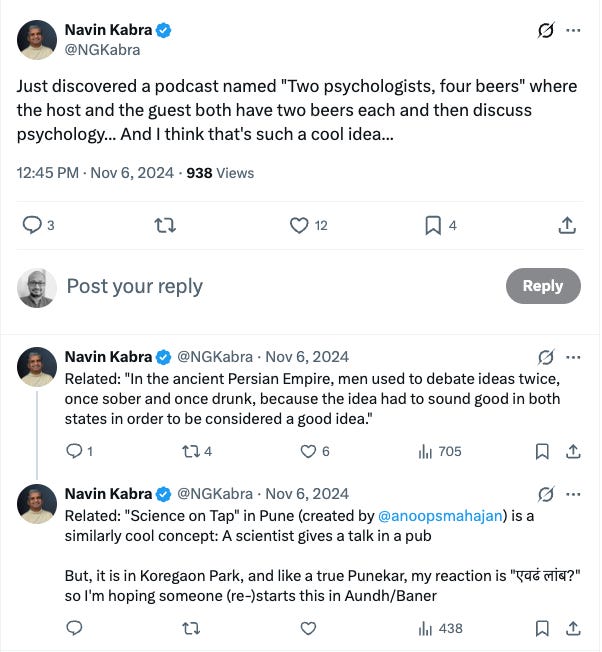
Three things happened after that. One, we got another reason to meet up and drink beer once again, this time with Navin. Two, Nagaraj, a Prof from IISER joined our little organizing committee. Harish Bhamidipati joined us a little while later too. And three, we realized that we would have to actually get this off the ground if we wanted to continue using this as an excuse to meet up and grab a couple of beers.
And thus was Pune Knowledge on Tap born.
Pune Knowledge on Tap (KnOT)
The idea behind KnOT is very simple, and is based on the Science on Tap series that used to happen in Pune. Science on Tap was Anoop Mahajan’s idea, and he was more than happy to both give us his blessings and share with us tips and tricks for what worked well and what didn’t with Science on Tap.
KnOT talks happen on (usually) the last Thursday of every month, and they always happen at Wynkk, in Aundh. Attendees at each event have to pay 300 rupees to enter, and are given a coupon which they can fully utilize inside to buy beer, non-alcoholic beverages, or anything else they like.
Folks grab a drink and have a chat for about half an hour before the talk begins, and are most welcome to stay back post the talk to chat with each other or the speaker. The talk lasts for about an hour, and we have a small WhatsApp community where we post updates, etc2. Chatham House Rules apply, and the talks are not recorded by design. The idea is to turn up and listen, in person.
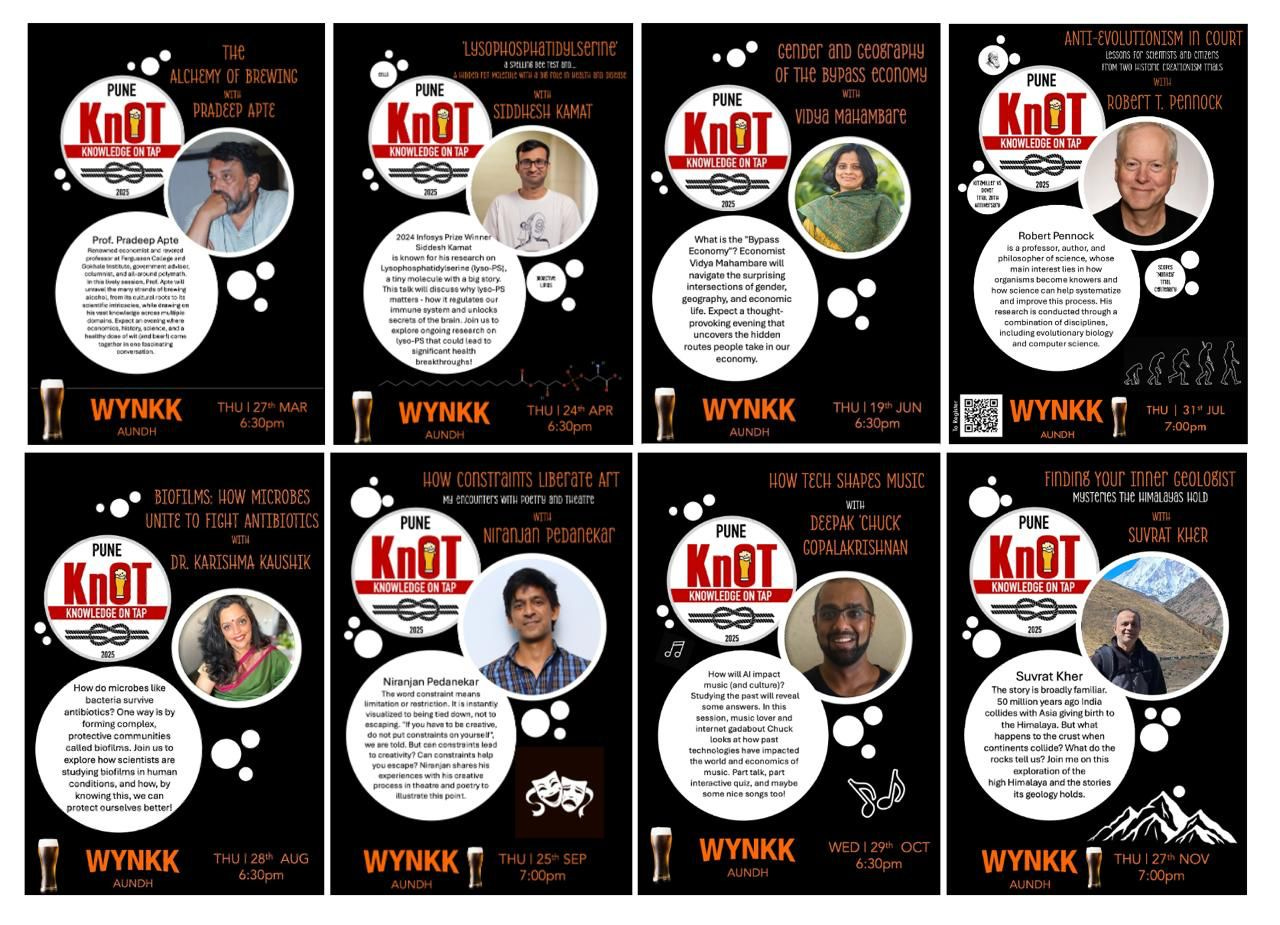
Prof. Pradeep Apte delivered the first talk, on the history of beer. We figured that was the most appropriate way to start, considering the nature of the talk (not to mention the story of how KnOT started!). Siddhesh Kamat was next, and he gave a talk on his research on lysophosphatidylserine. Vidya Mahambare gave a talk on India’s bypass economy in June, while Robert Pennock spoke in July on anti-evolutionism in court. Dr. Karishma Kaushik gave a talk on her work on biofilms in August, while Niranjan Pednekar gave a talk on how constraints liberate art in September. October was Deepak ‘Chuck’ Gopalkrishnan’s talk on how tech shapes music, while November was the geologist, Suvrat Kher, talking about how each one of us can (and should) discover our inner geologist.3
We rounded off 2025 by inviting Ravishankar himself to give a talk on the subject closest to his heart, the art and science of telling stories.
The Point is the Community
We were worried when we began the monthly talk series earlier this year. We were worried about a lot of things, but our chief worry was whether a series like this would garner enough of an audience, month after month.
And we’re glad to report that our worries were baseless. Every talk has been “sold out”, and we have our own little community that uses these talks as a way to meet-up, interact with other like-minded folks, and learn about something interesting in the bargain.
There are a lot of different ideas that each one of us organizers have about how we could do more with the community that we are building. The organizing principle and the motivation behind whatever we do will remain the same: helping build better communities, with the glue always being the ability to learn about interesting ideas as a community.
And that’s the reason I wanted to write this post - to explain that the whole point has always been to build up and expand our communities. Each of us, the folks behind KnOT, have had our own networks be enriched by meeting folks from each other’s circles. And this is true, it goes without saying, for everybody who attends these meet-ups.4
Making this happen, and sticking with it through 2025 has been one of the best things I have managed to do this year, and I hope we do an even better job of it in the coming year. One of the ways we could do a better job is by making many more such events take place.
So if you’d like to find out the hows and the whys and the why-nots that go into making something like this happen, please, feel free to reach out. Any one of us will be more than happy to try and help!
Here’s hoping I get to meet you soon at a community meet-up, and life would be even better if it happens to be one organized by you.
Cheers, and here’s to 12 more KnOTty problems to solve in 2026.
Why have I become a lurker. Honestly don’t know, but now have a very strong preference for wishing to remain so
Get in touch if you’d like to join
None of the organizers were in town in May
As Navin is fond of saying at every meet-up, one of our rules is that you should speak to at least one stranger before we leave.
superb!
Great article Ashish. Thank you for the backstory of Pune KNoT. I had read the Twitter post that Navin had written about Pune Science on the Tap, and so when this came about wasn’t surprised that Navin was involved.