

I hope you have a coping mechanism for the times we’re living in.
You know what I mean, right? When you’re done thinking about AI, Donald, your own country’s politics, and anything else that you choose to tax your brain about, you should do something that allows you to switch off. I’m talking about that coping mechanism.
Mine is watching old episodes of QI. QI is a lovely quiz show from England, and it is thirty to forty-five minutes of delicious trivia, with oodles of typically British humor for company. If you enjoy that sort of thing, you’ll love the show. You’re welcome.
Each season of QI is based on a letter. Each episode of Season 1, for example, was about things beginning with the letter ‘A’. The second season was about things beginning with the letter ‘B’, and you can see where this is headed. Now, one of the episodes in season 7 was about Germany. If you haven’t seen it, or haven’t heard of QI before, I highly recommend watching it.
One of the rules that the panelists on the show had to abide by in this specific episode was that they couldn’t talk about the war while answering questions about Germany. And in a great example of typically British humor, they did not (of course) specify which war the panelists couldn’t speak about. Much fun ensues.
So anyway, one of the questions in this episode was about this dog. What do you call it?


Both answers are correct, and it doesn’t matter which one you gave. That, as it turns out, was the point of the question:
The panel are show a picture of a dog and are asked what breed it is. The dog in question is a German Shepherd, which has been the official name for what was previously called the Alsatian since 1977. After World War One, English people stopped calling German Shepherds by this name because they did not like anything with German, so they called them Alsatian wolfhounds in 1918. The wolfhound was then dropped. (sic)
It makes us do weird things, the thing that the episode tells us can’t be mentioned. That’s the point today’s post makes, and we talk more about it in what follows.
Before Lego, They Used Pamphlets
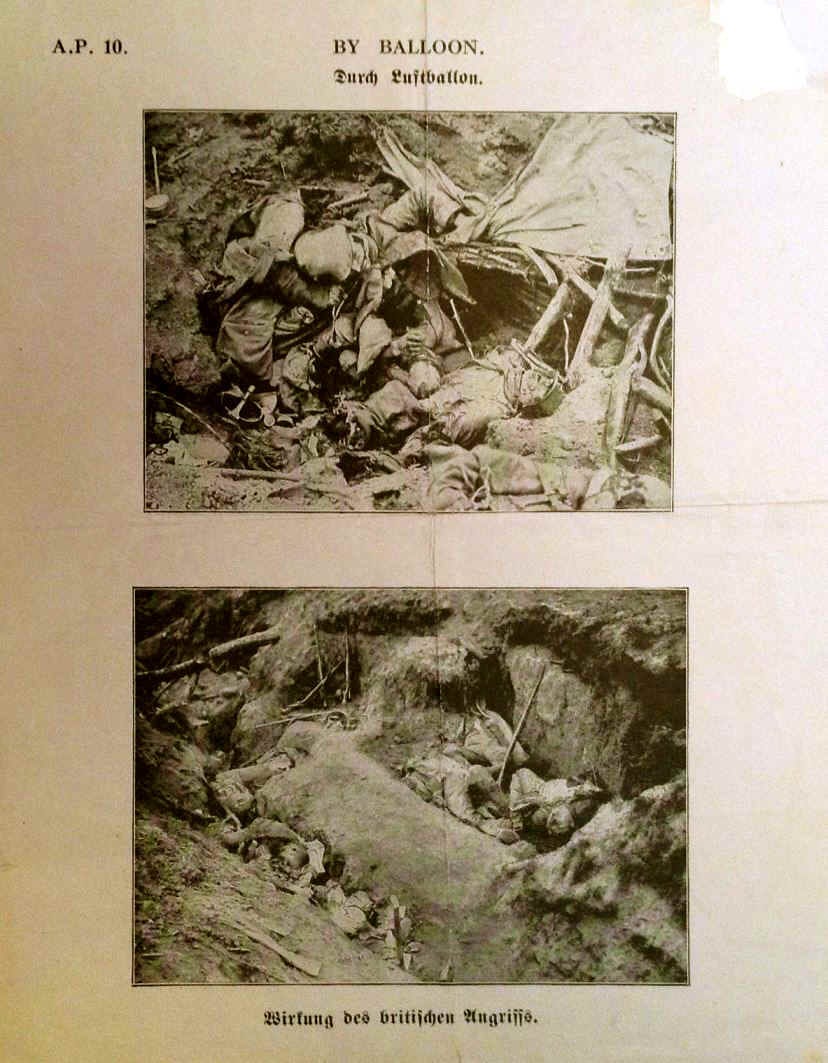
Airborne leaflet dropping is a type of propaganda where leaflets (flyers) are scattered in the air, normally by filling cluster bombs that open in midair with thousands of leaflets.
Military forces have used aircraft to drop leaflets to attempt to alter the behavior of combatants and non-combatants in enemy-controlled territory, sometimes in conjunction with air strikes. Humanitarian air missions, in cooperation with leaflet propaganda, can turn the populace against their leadership while preparing them for the arrival of enemy combatants.
Leaflet droppings have also been used to limit civilian casualties by alerting civilians of imminent danger allowing time to evacuate targeted areas.
Source: https://en.wikipedia.org/wiki/Airborne_leaflet_propaganda
All sides in all instances of the thing we cannot talk about have done this, because it made sense to do so. It increased confusion in the opposition, encouraged defections, and made clear to the other side what was really going on (and this is something both sides believed to be true for only their own side, which helped with the very first point). In the First World Thing We Cannot Talk About, the Germans and the British merrily dropped propaganda over enemy lines, and this was repeated in the Second World Thing We Cannot Talk About.
Propaganda during the thing we cannot talk about is probably as old as the thing we cannot talk about, and that which we cannot talk about is probably as old as humanity itself.
Now, follow my reasoning closely here, and take your time about it. The thing we cannot talk about isn’t even relevant to the current situation, because the current situation isn’t even an example of the thing we cannot talk about, per the government that started the thing we cannot talk about.
Which itself is an example of propaganda related to the thing we cannot talk about, if you think about it. I did tell you to take your time to think about it, you will recall.
But here is where things get interesting.
The Two AI Wars
Imagine a purely hypothetical scenario in which a country called A declares the initiation of major combat operations against another country called I. Further imagine that the country I was run by an authoritarian regime, which had ‘been struggling to shut down all footage of the protests convulsing the nation, cutting off internet access to the outside world in the longest blackout in I’s history’.
That makes the current Thing We Cannot Talk About genuinely interesting, because there are now two battlefields at play. One battlefield is where the actual Thing We Cannot Talk About is being fought. A’s territory is not involved in this battlefield, but I’s very much is.
But the propaganda about the Thing We Cannot Talk About? That is a major headache for A, because I had simply cut off its people’s access to that particular battlefield before major combat operations began on I’s territory.
But A’s people have access to that battlefield, as does the rest of the world. And the bad news for A is that while there is a ceasefire in the Thing We Cannot Talk About, there is no ceasefire in the propaganda about The Thing We Cannot Talk About.
Prior to the attacks, it looked as though some connectivity was returning to Iran, but as bombs fell, the blackout was once again in place. However, there were some early suggestions that Iran was going to selectively lift the blackout “for those who can carry our voice further” — a kind of tiered internet access for whitelisted people willing to promote, at the very least, an anti-war message. No one could have foreseen what would happen next.
By mid-March, the most dominant strain of Iranian propaganda was of a markedly different tone. Little Lego minifigures dressed up as soldiers as Lego planes and Lego helicopters burn in an AI-generated desert. Videos crammed in references to Jeffrey Epstein and dead Iranian schoolgirls alongside guns and explosions. It turned out that Lego AI slop was the voice that would carry the farthest.
Twitter But No Tear Gas
A little more than a decade ago, Zeynep Tufekci wrote a lovely little book called Twitter and Tear Gas. My understanding of the main thesis in her book is deeply rooted in economics:
Social media and memes greatly reduce the cost of organizing a movement online. That’s the good news.
The bad news is that opportunity costs are everywhere, and precisely because costs are low, starting a movement online is easy, but following through on actual change is that much harder.
But the major combat operations between A and I are different from Germany and England during the two World Things We Cannot Talk About. And they are also different from Zeynep’s framing from a decade ago.
First, I doesn’t have a battlefield in the propaganda combat operations. They have internet blackouts, remember? How do you even spread memes online in the Stone Age, anyway?
Second, I is able to produce content in A’s idiom, and for A’s audiences. A’s own government is unable to reciprocate in this battlefield, because of the first point above… but also because the A government’s memes are aimed towards A’s domestic audience, not I’s!
Production of memes ain’t the problem here. It is distribution1.
Costs for the production of hard-hitting memes (as opposed to hard-hitting bombs) have dropped to zero. The costs of distribution have dropped to zero for A’s audiences, but have scaled up dramatically if you want to reach I’s audiences. If you take away the second point from Tufekci’s analysis, it is easier than ever to optimize for her first point.
So easy, in fact, that anybody could do it. England and Germany had governments organizing production and the distribution of propaganda. You defeat the country, and you stop the production and the distribution of propaganda. But this is not your grandparents’ Thing You Cannot Talk About.
This time is different. But us humans? We’re the same. And that’s a problem.
AI, and Humanity at Large
It is not as if we are now living in a world where the narrative matters more. That has always been true, and you could argue that it is in fact one of the definitions of humanity. Signaling matters to us as a species. Ask Messrs Hanson and Simler, among others.
You win the Thing That We Shall Not Talk About by winning both battlefields, not just the physical one. And both sides of The Thing That We Shall Not Talk About know it.
I solemnly swear that I, Ashish Kulkarni, wrote this sentence (and the rest of the blog post, to boot). I’m willing to go to The Thing We Will Not Talk About on this!
Wonderful as always Ashish. You did let slip the word we were not supposed to talk about in the section heading "The Two AI word we are not supposed to talk about" :-) and if course the title of the article but a joy to read as always
Ashish, this is brilliant — and the QI framing is really clever. The conceit mirrors the argument: you can't even name The Thing properly, and yet The Thing keeps shaping everything.
Your two-battlefield thesis has a Catch-22 nested inside it. A won in the physical battlefield so comprehensively that it eliminated the very officials required to certify the victory. You cannot negotiate with the regime until you have destroyed the regime, but once you have destroyed the regime there is no one left to negotiate with. Meanwhile, on your second battlefield — the narrative one — I is winning precisely because it has no internet. No internet means no counter-narrative to manage, no dissent to suppress, no TikToks of your own casualties. The blackout that looks like a weakness is actually an advantage: it forces all content outward, into A's information space, in A's idiom, for A's audience. A's government is producing memes for its own base. I is producing memes for A's base. One of these is propaganda. The other is warfare.
I tried to follow the Catch-22 thread to its logical conclusion in a piece this week — a Heller-ian satire in which sovereignty enters the platform era and the Board of Peace is rebranded as the Board of Pieces.https://rajeshachanta.substack.com/p/catch-26
You're welcome :)