

We live in weird times. All of us say this all the time these days, but in this essay, I want to explain, at a rather deep level, why we feel this way. I think it is because we are on the verge of acquiring species-scale cognition. That’s the good news. The bad news is that we are about to do so without having acquired species-scale memory, species-scale legitimacy, species-scale experimentation, or, worst of all, species-scale institutions.
Those four species-scale absences — memory, legitimacy, experimentation, institutions — are the subject of this essay. To see why they are dangerous, and not merely nice-to-haves-that-are-unfortunately-not-around, we have to begin at a most mystifying place.
Let’s talk bananas.
The Cavendish Banana Problem
I learnt about the Cavendish banana problem years ago, on a wonderful podcast called The Real Food Podcast. Best as I can tell, this podcast is no longer available, but I have written about this before on these pages — here’s the link.
The bottom line is that banana growers figured out that there was a variety of banana that would “work” when the previous global favorite was attacked:
Cavendish bananas entered mass commercial production in 1903 but did not gain prominence until later when Panama disease attacked the dominant Gros Michel (”Big Mike”) variety in the 1950s. Because they were successfully grown in the same soils as previously affected Gros Michel plants, many assumed the Cavendish cultivars were more resistant to Panama disease. Contrary to this notion, in mid-2008, reports from Sumatra and Malaysia suggested that Panama disease had started attacking Cavendish cultivars.
After years of attempting to keep it out of the Americas, in mid-2019, Panama disease Tropical Race 4 (TR4) was discovered on banana farms in the coastal Caribbean region. With no fungicide effective against TR4, the Cavendish may meet the same fate as the Gros Michel.
Whether it was the Gros Michel then or the Cavendish today, the reason each won out was the same. These varieties ship well, ripen well, and can be easily standardized — and can therefore be mass-produced and sold in large volumes.
And let us not gloss over what that victory bought! Opportunity costs are everywhere, yes? The Cavendish became one of the cheapest, most reliably available fruits on the planet. In effect, an anti-poverty program in a yellow wrapper. Standardization fed people, and it fed them cheaply. That is why monocultures have a tendency to keep winning: they do deliver.
That’s the good news.
The bad news is that variance disappeared from bananas. When a threat appears on the horizon — the TR4 fungus, say — your kingdom is especially vulnerable. Why? Because there is only one variety to attack. The fungus does not have to adapt to different species, precisely because there are no other species left to attack.
A monoculture can scale well. It is also trivially simple to destroy, precisely because it has scaled well.
This matters to us because civilizations can face the same problem. Here too, attempts to scale select for what travels well across cultures. Institutions that are easy to understand, replicate, and superficially customize gain ground — and so do standardized education, the language of consensus, globally trusted brands, and much else besides. Such a civilization is globally portable, it is true. But by the same token it is less adaptive in the face of a shock, because it no longer carries enough variance to draw on.
That is the first danger. There is a second danger, and it is worse — but to see it we need to notice that the bananas are not the only thing that has stopped being weird.
We Don’t Go Bananas Enough Anymore
I started this essay by saying we live in weird times. That’s true, but with a fittingly weird twist. The times are weird, but us people? We, increasingly, are not.
Adam Mastroianni had a lovely essay out a while ago on exactly this, and it is worth reading in full:
People are less weird than they used to be. That might sound odd, but data from every sector of society is pointing strongly in the same direction: we’re in a recession of mischief, a crisis of conventionality, and an epidemic of the mundane. Deviance is on the decline.
Adam takes us on a whistle-stop tour of the many ways in which we have become more uniform and less quirky — from some particularly welcome trends (declines in smoking and teenage pregnancies) to some deeply unwelcome ones (”Before 2000, for instance, only about 25% of top-grossing movies were prequels, sequels, spinoffs, etc. Now it’s 75%”). But his basic point is the one I want to borrow: we are just not as weird as we used to be. And not only are we less weird — we are all less weird in the same boring ways.
Economists have been circling this too. Tyler Cowen’s The Complacent Class documented the economic version of the same phenomenon years ago: Americans moving house less, starting fewer firms, crossing state lines less often. The recession of weirdness shows up in the economics too!
Here is why that is not merely an aesthetic complaint. Deviance is the raw material that cultural evolution works on. It is the variance. Once you strip it out, you don’t just get mediocre movies and blander buildings; you get fewer live experiments — fewer genuinely different ways of doing school, of organizing a city, of running an institution, all being tried at once and graded by reality.
You may well ask: hasn’t diversity exploded? You can order from among forty cuisines tonight and stream music from every continent. There is more variety available to any one of us than any royal personage ever commanded. True. But that is menu diversity, and menus are not experiments. The variance a civilization adapts with is variance across ways of actually living — schools, cities, and institutions being run differently, and finding out what happens. The menus get longer everywhere, it is true. But is it also true that they converge everywhere on the same long list?
And if fewer experiments are running, then our civilization, like the banana, is converging on a single variety. This is not just confined to the arts, note. There are serious thinkers who believe we face exactly this problem at the scale of the whole civilization.
A Robin in the Coal Mine
You should go back and read Robin Hanson on this — Staying Like Foragers is a good entry point, though he’s been circling the theme for the better part of a decade.
Here is my summary of the Hansonian framing: it says that modern culture has drifted back toward forager-like habits. Foragers are suspicious of dominance and of hierarchy, and they work by consensus. That is, they like to talk, and they are inclined to be suspicious of what they perceive to be dangerous powers.
Personally, I think there’s a simpler story to be told, and you don’t have to force-fit the world into a forager-farmer frame to tell it. Modern civilization may be less a forager civilization than a civilization where talk has become much cheaper than action. Elite discourse, incessantly performative online politics, global coordination, compliance layers, reputational risk — all of it makes it easier to talk about problems. As compared to what? As compared to actually running experiments that have to meet reality.
We have become talkers, not doers. Or, if you prefer the sci-fi version: we are all from Golgafrincham now. And as with everything Douglas Adams wrote, there’s a serious truth under the giggling: a civilization turns fragile when talking gets cheaper faster than doing does.
Before you object, let me point at the elephant — or rather, at the datacenters. Are we really talkers? The last few years have seen the largest private infrastructure buildout in human history: fabs, datacenters, gigawatts of grid hookups. Don’t forget that we got vaccines in eleven short months! We live in an age where rockets land themselves.
All true, and all genuinely done rather than “talked”. But notice where the doing lives: in the technical domain, almost exclusively. We run a thousand experiments a year on chips and models, and almost none on institutions.
When did you last see a genuinely new kind of school, city, or constitution get a real trial? (By the way, if Alpha School is what comes to mind, I’d say you’re making my point for me. If all of us remember just that one experiment...)
Our civilization has splendid variance in its gadgets and a monoculture in its institutional forms — we experiment with everything except the ways we live together. The talk, in other words, is concentrated precisely where the experiments matter most.
Now, re: the second danger from the banana section that I spoke about above. It isn’t only that a monoculture is easy to knock over. It’s that a monoculture has stopped evolving — there is nothing left for selection to act on. A civilization in which talk is cheap and experiments are rare is a civilization that has stopped running the trials that adaptation requires. It is not evolving, precisely because it is not experimenting. It is now drifting. That is the deeper reason to worry, and it is why less-weird is not a small thing: we are not just more boring, we are more boring in the same way, all at once.
That just so happens to be the definition of a monoculture.
These things are hard to think about, but I hope you will allow me one additional layer of complication. Variation exposed to consequences is how anything adapts — but adaptiveness is a constraint, not a compass. It helps you understand what will survive, but it doesn’t tell you what is worth surviving. Adaptation is a value-less process, in the sense that it simply predicts survival, not desirability in any other dimension.
A civilization that worships selection for its own sake has confused “did not die” with “was worth preserving.” We need variance because a civilization without it cannot learn, but variance alone cannot tell you what is good and worth preserving.
So who can tell you what is good? Need we ask anyone to tell us these things?
A Tale of Two Stacks
Any civilization needs a basic stack for making material abundance possible. Humans cannot exist without energy and food, so any civilization has to begin by figuring out how to make energy and food available with some regularity and something approaching plenitude.
Over time, societies figure out how to work better with matter, with tools, and eventually with infrastructure, scaling up the availability and quality of food and energy. This is enabled and reinforced by better coordination, but this flywheel needs some things to get going. We need shared memory, and therefore language, and eventually culture and education. Do this well enough for long enough and you arrive, eventually, at the stage we’re at now. Call this the material-dependence stack. It begins with the oldest question humans ever asked, in a thousand different places: do we have enough food, and do we have enough energy? Vaclav Smil is a good place to begin if you want to learn more about this topic.
But civilizations do not grow by materials alone, much as man does not live by bread alone. Having the materials is one thing; choosing to do something with them is quite another. And choosing to do something at civilizational scale also requires a stack — same same, as the line goes, but different.
This is the agency stack. Those who, a generation or two ago, chose to start walking the path toward machine intelligence did not start from nothing. They inherited a shared memory, language, culture, and education older than any of them by millennia. They could coordinate; they had institutions willing to help them; and they had some measure of legitimacy. Not universal and not public, I grant you, but the very fact that serious institutions were willing to back them, financially and otherwise, is proof that the legitimacy was real. They could count on infrastructure, on extraordinarily sophisticated tools, and on a deployment capacity that was, quite literally, civilizational.
A civilization does not build an electricity grid, or an AI stack, or a space program merely because the materials and the know-how are lying around. It also needs the collective will, the daring to imagine, the blessing of institutions willing to sacrifice resources, the coordination of many actors, the financing, and the sheer chutzpah to pull it off. That — and more besides — is agency.
Here is the thing that makes these two worth separating. They contain almost the same ingredients — energy, matter, coordination, memory and culture, cognition — but in reversed order. For a body, energy comes before culture: no calories, no thought. For a civilization deciding what to do, culture comes before energy: a grid, a food system, or a compute cluster at civilizational scale is first imagined, then financed, then permitted, then publicly defended, and has to gain legitimacy in all of these before a single spade goes into the ground.
The material stack runs upward, from energy to cognition. Call this the order of what must be physically possible. The agency stack runs the other way, from shared memory and legitimacy down into the remaking of energy and infrastructure. Call this the order of collective choice.
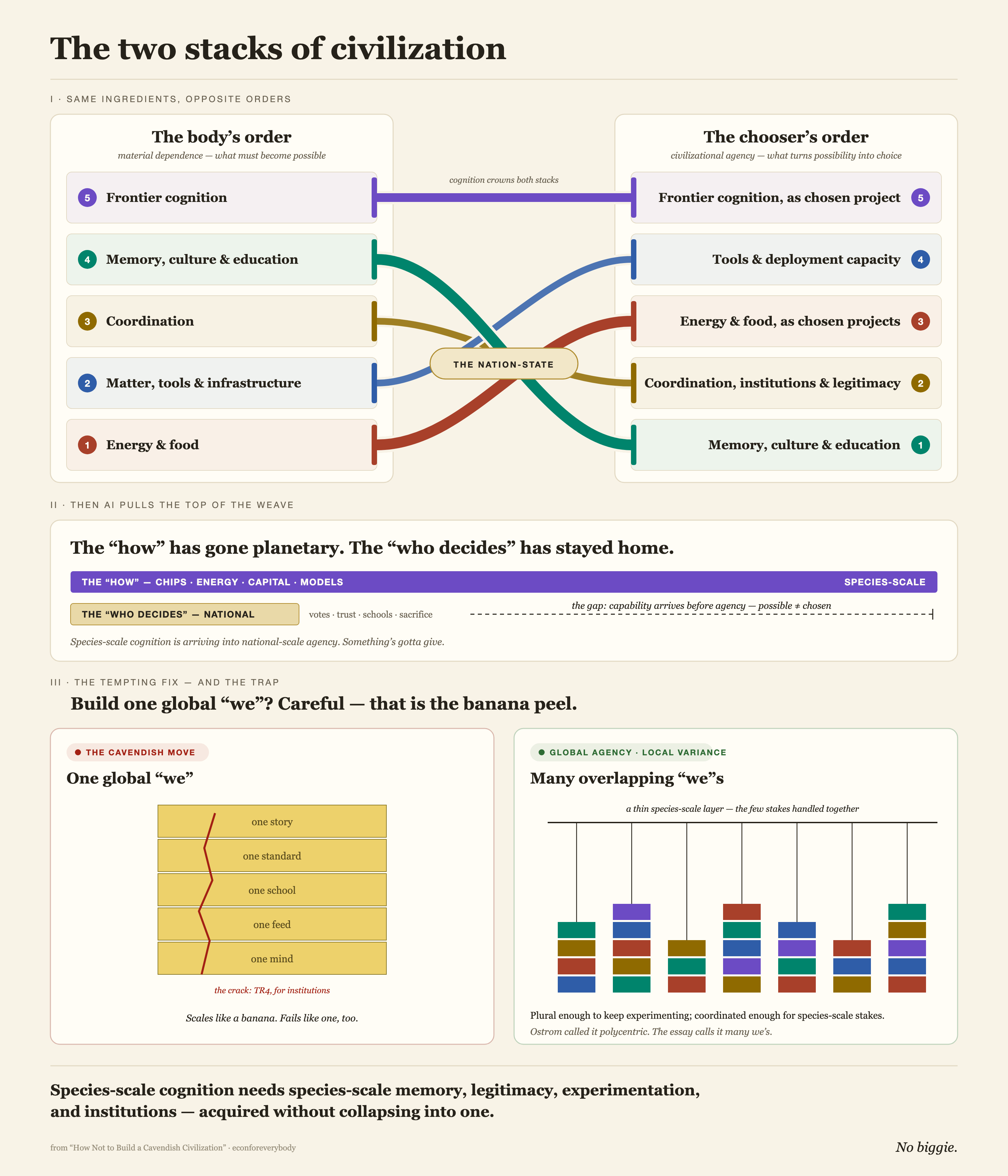
The two stacks also look in different directions when it comes to matters temporal. The material stack tends to look back: it counts what has been hard-won over millennia and asks what must be preserved. The agency stack tends to look forward: it counts what is now possible and asks what might be dreamt, and therefore done.
AI is the sharpest example of the agency stack today, but it is one of many — the urge to colonize Mars (Musk is only the latest, and perhaps so far the greatest, in a long line of dreamers), the dream of capturing the sun’s whole output, the ambition to end death itself. What these share is the outrageousness of the dream, and the appetite for an even more outrageous one. But both orientations live inside the same civilization at the same time, and both are true. A civilization that only preserves ossifies; one that only dares burns through the substrate it depends on. The interesting action is where the two stacks are forced to negotiate. Which is where the nation-state comes in.
The Nation-State Was the Old Bridge
For a very long time, the two stacks have had a workable compromise, and its name is the nation-state. Nations were how you told people a shared story, ran a shared school system, raised a shared tax base, and kept legal order within a boundary. And for anything the nation decided was worth doing, it became possible — even natural — to draw down the nation’s reserves of energy, food, roads, and ports. The nation was not merely an identity. It was, in modern jargon, a stack-aligner: it let shared memory and legitimacy reach all the way down into grids, factories, science, and deployment. It made material ambition politically imaginable.
But that bridge was always built at a particular scale, and it never covered the whole species. Better coordination, better-documented shared memory, better culture and education — all of it worked, but in fragments. And it was, and is, mediated by geography, circumstance, politics, and war. The material stack, surveying its own achievements, tends toward skepticism rather than joy. It does not concede that we live in an age of universal abundance, and it certainly does not automatically concede that all of a civilization’s resources should be pooled for some common goal.
AI Is an Agency-Stack Initiative
The trouble with AI, in this telling, is that it pushes cognition, compute, security risk, energy demand, and the consequences of deployment beyond the scale at which nation-states conceive their goals, let alone operationalize them.
The second trouble is a split down the middle of the thing. The physical and technological inputs that go into AI are now unmistakably global — the chips, the energy, the supply chains, the capital. But the emotional weight of AI, and the legitimacy we confer on it, remain stubbornly national. The “how” has gone global, but the “who decides” has stayed at one, possibly two homes. (If you are thinking that two homes at least means two varieties, you are right, but it is cold comfort. A duopoly of cultivars is but an orchard with only two bananas in it.)
This makes the national layer at once necessary and insufficient. Necessary, because people still trust, vote, learn, sacrifice, and belong overwhelmingly through national and sub-national forms. Insufficient, because the systems being governed have outgrown the container. Take AI as the test case: for everyone in the other 190 homes, the insufficient half of necessary-and-insufficient is not an abstraction.
The math won’t math unless you talk about international cooperation at some point. Something’s gotta give. That much is clear at even a cursory glance.
The Trap
Now, if the agency stack is stuck at national scale while the stakes have gone global, then for something to not give, we must build the missing layer. One global agency stack: one forum where the species decides, one set of standards, one story large enough to legitimate species-scale projects — one “we”, in other words, that is the size of the problem.
You might object that we have already built a global layer, because what else was Bretton Woods? Consider the UN, the WTO, the IPCC, the whole alphabet soup. Well, true. But look at what we built it out of: talk. Summits, communiqués, frameworks, declarations — Golgafrincham International, in other words. And its toothlessness is precisely what makes the case for a muscular replacement sound so very reasonable.
And here we ask the question this essay has been working towards:
Will we slip on a banana peel?
Because a single global agency layer — optimized for coordination, legible across every culture, standardized enough to actually function — is a Cavendish. It is the banana strategy applied to institutions, and then to culture itself. A global “we” could coordinate, yes. In fact, we could coordinate well for a long time. Recall that the Cavendish banana solution “worked well” for a long time! But never forget the opportunity cost of a Cavendish-style solution. Yes, you get the legibility, the consensus-shaped governance, and the safe portability — but you also delete in the process the variance that the first half of this essay said a civilization cannot survive without.
Do you see the problem? A global layer for the agency stack may be the cure for the insufficiency of the national one. But the most natural way to build it — one consensus, one standard, one story — is itself the monoculture disease. Large language models themselves might be the tastiest banana of all! But that is a matter for a separate essay.
This is why “just coordinate globally, we have AI, no?” is not the answer. Hanson has been warning about a version of this for years. The banana explains why he is right to worry. It is the trap wearing the answer’s clothes.
Many We’s
You cannot pick the winning experiment in advance, for the simple reason that you cannot know the winner in advance. The evolution of a civilization should not collapse to a binary, let alone to a single winner chosen up front.
There are two ways to fail, and the whole task is to maintain a healthy tension between them.
One global monoculture that deletes deviance in the name of coordination. This is the Cavendish death — smooth, legible, superbly coordinated, and one fungus away from collapse.
Many local identities so jealous of their boundaries that they can coordinate on nothing at species scale. This is drift into fragmented paralysis, while the stakes go planetary without us.
And let us be honest about the default path, because doing nothing does not park us safely in between these two failures. If no plural layer gets built, the one or two homes will set the standards anyway — compute thresholds, safety rules, export controls — and the other 190 will take them. Drift does not produce pluralism. It produces monoculture without consent, which is the worst of both.
What we need is global agency with local variance. We need many we’s! A civilization that can think at the scale of the species without thereby becoming a single, shippable, fragile variety of thought. Nation-states need to evolve to something that they aren’t today, without coalescing into a fragile monolith that can succumb to a common cold.
This is not a utopian ask, far from it. Political scientists have a name for it — Elinor Ostrom called it polycentric governance, and spent a Nobel-winning career showing that overlapping, nested centers of decision-making are not necessarily chaos. They are, instead, how commons actually get governed.
Species-scale cognition is here, or will be here any moment now, depending on which definition you buy. Species-scale memory, legitimacy, experimentation, and institutions are not here yet. The most tempting shortcut to building them would build the wrong thing. We (and remember, there have to be many of us we’s!) have to acquire all four without collapsing into one.
No biggie.
Great post. Now you have to follow it up with a post on d/acc (Vitalik's proposed solution to this problem): https://vitalik.eth.limo/general/2025/01/05/dacc2.html
1. This article makes the long wait completely worth it. Thanks!
2. Can I blame the institutional convergence on the envy of social "sciences" and move on?
3. Network School by Balaji, UATX, Takshashila